
Dust is the relentless enemy of every homeowner, it settles on furniture within hours of cleaning, aggravates allergies, and makes spaces feel dingy no matter how often you vacuum. If you’ve ever wondered whether an air purifier will help with dust or if it’s just another gadget collecting dust itself, the short answer is yes: a properly selected and positioned air purifier can significantly reduce airborne dust particles in your home. But there’s more to it than plugging one in and hoping for the best. Understanding how these units work, what types of dust they tackle, and how to use them correctly will determine whether you see real results or just run up your electric bill.
Table of Contents
ToggleKey Takeaways
- A properly selected and positioned air purifier can significantly reduce airborne dust particles when sized correctly for your room with a CADR rating at least two-thirds of the square footage.
- True HEPA filters capture 99.97% of particles down to 0.3 microns, making them the gold standard for dust control, while avoiding inferior ‘HEPA-type’ filters that may only capture 85% of particles.
- Air purifiers excel at trapping textile fibers, pet dander, pollen, and skin cells but cannot remove dust already settled on surfaces, requiring regular vacuuming and cleaning as complementary strategies.
- Run your air purifier continuously on low or auto mode, replace HEPA filters every 6 to 12 months, and maintain 12 to 18 inches of clearance around the unit for maximum effectiveness against dust.
- Air purifiers work best as part of a comprehensive dust control strategy that includes reducing dust sources, maintaining proper humidity levels (30-50%), using HEPA-filtered vacuums, and sealing HVAC ductwork issues.
How Air Purifiers Capture and Reduce Household Dust
Air purifiers work by drawing air through a series of filters that trap particles before recirculating cleaner air back into the room. The process is straightforward: a fan pulls in air, filters capture contaminants, and purified air exits. For dust control, the filter quality and airflow rate (measured in cubic feet per minute or CFM) determine effectiveness.
Most units cycle the air in a room multiple times per hour, look for models rated for at least four to five air changes per hour (ACH) in the space you’re treating. A purifier rated for 300 square feet won’t cut it in a 500-square-foot living room, no matter how expensive it is.
The Science Behind HEPA Filters and Dust Particles
HEPA filters (High-Efficiency Particulate Air) are the gold standard for dust removal. True HEPA filters must capture at least 99.97% of particles 0.3 microns in diameter, which includes most household dust, pollen, and mold spores. Dust particles typically range from 0.5 to 100 microns, well within HEPA’s capture range.
The filter works through three mechanisms: interception (particles follow air streamlines and stick to fibers), impaction (larger particles can’t navigate around fibers and collide with them), and diffusion (ultra-fine particles bounce randomly and eventually hit a fiber). This isn’t just surface-level trapping, dust becomes physically embedded in the dense fiber matrix.
Some manufacturers advertise “HEPA-type” or “HEPA-like” filters. Skip these. They’re not held to the same standard and may capture as little as 85% of particles. Stick with units labeled True HEPA or H13 HEPA (a European standard that’s even more stringent). Independent testing by cleaning experts has confirmed that genuine HEPA filtration delivers measurable reductions in airborne dust within hours of operation.
What Types of Dust Can Air Purifiers Remove?
Not all dust is created equal, and understanding what’s floating in your home helps set realistic expectations.
Common dust sources air purifiers handle well:
- Construction dust (drywall, sawdust, plaster): Larger particles settle quickly, but the fine airborne fraction from sanding or cutting stays suspended for hours. A purifier will capture this before it coats every surface.
- Textile fibers: Carpet, upholstery, and clothing shed constantly. HEPA filters excel at trapping these.
- Skin cells and hair: Humans shed roughly 30,000 to 40,000 dead skin cells per minute. Air purifiers reduce this biological dust load.
- Pollen and outdoor particulates: Tracked in on shoes or blown through open windows, these are prime HEPA targets.
- Pet dander: Microscopic flakes of skin from cats, dogs, and other animals. Often the main reason people ask, “Would an air purifier help with dust?”
What they struggle with:
- Heavy settled dust: Once dust lands on shelves or floors, an air purifier can’t help. You still need to vacuum and wipe surfaces.
- Ultra-fine combustion particles: Cigarette smoke, wildfire smoke, and diesel exhaust contain particles smaller than 0.1 microns. While HEPA filters capture many of these, adding an activated carbon filter boosts performance.
- Dust mites: Air purifiers don’t kill mites living in bedding or upholstery. They can capture airborne mite waste (a major allergen), but controlling mites requires washing linens in hot water and using mattress encasements.
If you’re dealing with construction debris or renovation dust, pair your purifier with plastic sheeting to isolate the work area and change filters more frequently, drywall dust clogs filters fast.
Choosing the Right Air Purifier for Dust Control in Your Home
Walk into any big-box store and you’ll find dozens of models with confusing specs. Focus on these key factors:
Room size and CADR rating:
The Clean Air Delivery Rate (CADR) measures how many cubic feet per minute of clean air the unit produces for dust, pollen, and smoke. For dust control, look for a CADR rating that’s at least two-thirds of your room’s square footage. A 250-square-foot bedroom needs a dust CADR of roughly 165 or higher.
Filter type:
- True HEPA is non-negotiable for dust.
- Pre-filters (often washable mesh or foam) catch larger particles like pet hair and extend the HEPA filter’s life.
- Activated carbon filters handle odors and VOCs but don’t add much for dust alone. Skip them if budget is tight.
Noise level:
Air purifiers run continuously for best results. Check the decibel rating, anything over 50 dB on high speed will be noticeable. Many units offer a “sleep mode” around 30-35 dB, roughly as quiet as a whisper.
Filter replacement cost and frequency:
HEPA filters typically last 6 to 12 months depending on usage and air quality. Replacement filters can run $30 to $100 each. Factor this into your total cost of ownership. Some brands use proprietary filters that cost more than generic options.
Smart features vs. simplicity:
Air quality sensors, auto modes, and app connectivity are convenient but not essential. A basic unit with a manual fan speed dial will reduce dust just as well if sized correctly. Save money here unless you want the convenience.
Recent air purifier testing in real-world home environments shows that mid-range models often perform as well as premium units for basic dust removal, provided the CADR rating matches the room size.
Where to Place Your Air Purifier for Maximum Dust Reduction
Placement matters as much as the unit itself. A purifier shoved in a corner behind a couch won’t circulate air effectively.
Best practices:
- Position it near the source: If you have pets, place the unit where they spend most of their time. For a woodworking shop or craft room, set it near the dust-generating activity.
- Maintain clearance: Leave at least 12 to 18 inches of space on all sides for unrestricted airflow. Don’t tuck it under furniture or against walls.
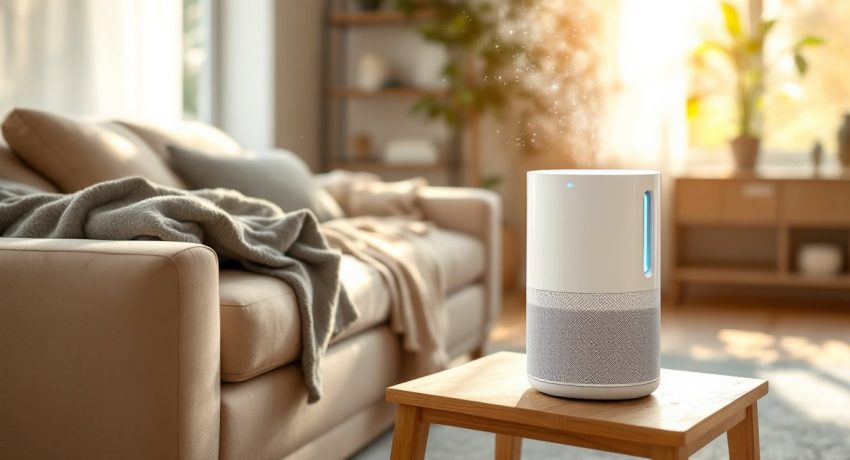
- Elevate when possible: Placing the unit on a small table or stand (rather than the floor) helps it capture dust particles that are still airborne rather than those that have already settled.
- Central location in open floor plans: In living rooms or open kitchens, a central position allows the unit to pull air from multiple directions.
- Avoid corners and tight spaces: Air tends to stagnate in corners. A purifier placed there will recirculate the same pocket of air rather than treating the whole room.
Multiple rooms:
One air purifier can’t treat an entire house unless you have an open floor plan under 400 square feet. For whole-home coverage, you’ll need a unit in each frequently occupied room (bedrooms, living room, home office). Alternatively, consider a whole-house HEPA filtration system integrated with your HVAC, this requires professional installation and costs $1,000 to $2,500, but it treats all air circulating through ductwork.
Don’t block return vents: If you have forced-air heating or cooling, don’t place a portable purifier directly in front of return vents. This disrupts airflow patterns and reduces both systems’ efficiency.
How to Maximize Your Air Purifier’s Effectiveness Against Dust
Buying the right unit and placing it correctly is half the battle. These steps ensure you get the most dust reduction:
Run it continuously:
Air purifiers aren’t like vacuums, they work best when left on. Dust is constantly generated, so intermittent use lets particles accumulate. Set it to low or auto mode if noise or energy use is a concern, but keep it running 24/7.
Replace filters on schedule:
Clogged filters reduce airflow and let dust pass through. Mark filter change dates on your calendar or use the unit’s indicator light (if equipped). If you live in a dusty area or have pets, check filters monthly and replace early if they look dirty.
Pre-filter maintenance:
Many units have a washable pre-filter. Vacuum or rinse it every 2 to 4 weeks to prevent dust buildup from choking airflow. This simple step can extend your HEPA filter’s life by months.
Reduce dust sources:
- Use doormats and remove shoes indoors to cut tracked-in dirt.
- Vacuum with a HEPA-filtered vacuum at least twice a week. Standard vacuums exhaust fine dust back into the air.
- Wash bedding in hot water (at least 130°F) weekly to control dust mites.
- Minimize clutter, knickknacks and open shelving collect dust.
Close windows on high pollen or dust days:
Air purifiers work against outdoor pollution, but leaving windows open during windstorms or high pollen counts overwhelms the filter. Use the purifier with windows closed for best results.
Pair with humidity control:
Indoor humidity between 30% and 50% prevents dust from becoming airborne. Too dry, and particles float freely: too humid, and mold becomes an issue. A hygrometer (under $15 at most hardware stores) lets you monitor levels.
Limitations: What Air Purifiers Can’t Do About Dust
Air purifiers are powerful tools, but they’re not magic. Understanding their limits prevents frustration.
They don’t eliminate the need for cleaning:
An air purifier reduces airborne dust. It won’t remove dust that’s already settled on baseboards, ceiling fans, or behind furniture. You’ll still need to vacuum, dust, and mop regularly. Think of the purifier as a partner in dust control, not a replacement for housework.
They can’t fix poor ventilation or HVAC issues:
If your home has leaky ductwork, a dirty furnace filter, or inadequate ventilation, a portable purifier is a band-aid. Address the root cause. Replace HVAC filters every 1 to 3 months with a MERV 8 to 13 filter (MERV 13 approaches HEPA performance). Seal duct leaks with mastic sealant (not duct tape, which degrades).
Limited range:
Portable units treat one room effectively. They don’t pull air through walls or doorways well. If you close bedroom doors at night, each bedroom needs its own unit.
Settled dust stays put:
Once dust falls onto surfaces, it’s out of reach. Disturbing it (vacuuming, walking on carpet, making the bed) kicks it back into the air, where the purifier can capture it. That’s why running the purifier during and after cleaning sessions helps.
Maintenance is mandatory:
Skip filter changes, and performance plummets. A dirty filter can’t capture new dust and may even release trapped particles back into the air. This isn’t a set-it-and-forget-it appliance.
Not a substitute for source control:
If you’re generating excessive dust from ongoing construction, a leaky attic, or a poorly sealed crawl space, an air purifier will struggle to keep up. Seal the source, then use the purifier to handle residual particles.
Recent evaluations of top models confirm that even the best air purifiers deliver diminishing returns if basic home maintenance and cleaning habits aren’t in place. They’re highly effective as part of a comprehensive dust control strategy, not as a standalone solution.