
A miter saw sitting on a cramped workbench is a recipe for frustration. Without proper side support, long boards tip, cuts go off-square, and measurements drift. A dedicated miter saw table solves all three problems, it stabilizes workpieces, extends your cutting capacity, and turns a single tool into a repeatable cutting station. Whether someone’s trimming out a basement or building furniture, the right table setup pays dividends in accuracy and speed. This guide covers what makes a miter saw table essential, the types available, key features to prioritize, and how to build one from scratch.
Table of Contents
ToggleKey Takeaways
- A miter saw table eliminates cut inaccuracy by providing infeed and outfeed extensions that keep long workpieces level and aligned throughout the cut.
- Portable miter saw tables suit contractors and hobbyists with limited space, while permanent installations deliver superior rigidity and storage for dedicated workshop environments.
- A level worksurface within 1/16 inch tolerance and integrated T-track stop block systems are essential features that enable repeatability and production efficiency.
- DIY custom miter saw table builds cost $100–$500 and take a weekend, offering full customization, while commercial stands ($150–$600) assemble quickly and ship ready to use.
- Proper dust collection ports, adequate extension length (48+ inches per side), and durable worksurface materials like 3/4-inch plywood prevent safety hazards and long-term maintenance issues.
- Top commercial options like the DEWALT DWX726 and Kreg KMS8000 Track System balance portability, precision, and expandability, making them ideal for different workshop scales and project types.
What Is a Miter Saw Table and Why You Need One
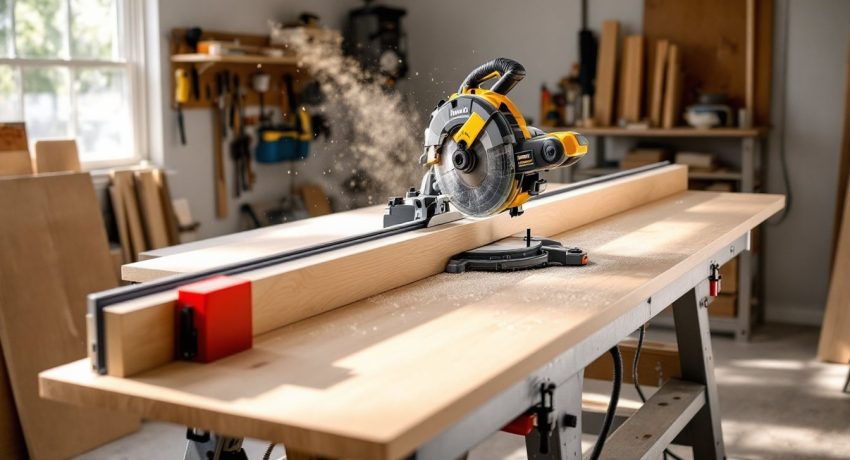
A miter saw table is a dedicated work surface designed to support both the saw and the material being cut. Unlike a standard workbench, it features infeed and outfeed extensions on either side of the blade, keeping long stock level throughout the cut. Most designs position the saw’s base at the same height as the side supports, creating a continuous flat plane.
The primary benefit is cut accuracy. When an 8-foot baseboard or a 10-foot 1×6 droops off the edge of a bench, it pulls the workpiece out of alignment mid-cut. Side supports eliminate that movement. The second advantage is repeatability, many miter saw tables include built-in stop blocks or T-track systems, allowing someone to cut dozens of identical pieces without re-measuring.
Finally, a proper table improves safety. Material that’s fully supported won’t twist or bind against the blade, reducing kickback risk. For anyone doing trim carpentry, deck building, or furniture projects, a miter saw table isn’t optional, it’s foundational infrastructure.
Types of Miter Saw Tables for Different Workshop Needs
Portable vs. Permanent Miter Saw Tables
Portable tables use folding legs or a mobile base and typically break down for storage or transport. They’re built from lighter materials, plywood, aluminum extrusions, or MDF, and often include wheels. Portable setups work well for contractors moving between job sites or hobbyists with limited garage space. Trade-off: they sacrifice some rigidity compared to fixed designs, and repeated setup/teardown can wear mounting hardware.
Permanent tables are anchored to a shop wall or built as freestanding benches from dimensional lumber and sheet goods. They often incorporate storage cabinets below, dust collection integration, and heavier worksurfaces that dampen vibration. These are ideal for dedicated workshop spaces where the saw stays in one spot. The extra mass and bracing translate to cleaner cuts, especially with a 12-inch sliding compound miter saw, which can generate noticeable flex on lightweight stands.
DIY Custom Builds vs. Pre-Made Solutions
DIY custom builds let someone tailor dimensions to their saw model, shop layout, and typical workpiece lengths. A homemade table can incorporate T-track for stop blocks, electrical outlets, and tool storage exactly where needed. Material costs typically run $100–$200 for a basic plywood-and-2×4 design, or $300–$500 for hardwood and premium hardware. The downside: it requires a weekend of work and a comfort level with joinery and leveling.
Pre-made solutions include commercial miter saw stands (often tubular steel with adjustable extensions) and modular workbench systems. They assemble in under an hour and ship with integrated mounting brackets. Quality commercial stands range from $150 to $600. They’re a good fit for someone who wants to start cutting immediately or who lacks the tools to build from scratch. But, they rarely match the storage capacity or customization of a DIY build.
Essential Features to Look for in a Miter Saw Table
Level worksurface across all three zones, the saw base and both wings must sit on the same plane, within 1/16 inch. Even small height differences cause workpieces to snag or lift during the cut. Use a straight 8-foot board as a reference when setting up or building the table.
Adequate extension length depends on the longest stock someone typically cuts. For trim work with 8-foot boards, each side should extend at least 48 inches from the blade. Shorter extensions mean manual support or a second person holding the far end.
Integrated stop block system is non-negotiable for production work. A stop block clamps to the fence at a fixed distance from the blade, allowing identical cuts without a tape measure. T-track systems (standard 3/4-inch or 1-inch aluminum track) accept aftermarket stops, hold-downs, and dust collection fittings.
Dust collection port positioned behind the saw base captures the bulk of sawdust before it coats the workspace. A 2.5-inch hose connects to a shop vac or dust collector. Many experienced woodworkers recommend reviewing workshop dust collection strategies to integrate proper airflow.
Storage capacity below the table keeps blades, wrenches, and measuring tools within arm’s reach. Open shelving works, but drawers or cabinets keep tools cleaner in high-dust environments.
Material durability: The worksurface should resist warping and surface damage. Three-quarter-inch MDF or plywood is standard: some builders laminate the top with hardboard or melamine for a smoother, more durable face. Avoid particleboard, it sags under the saw’s weight and crumbles around mounting bolts.
How to Build Your Own Miter Saw Table: Step-by-Step Guide
Materials and Tools
• Two sheets 3/4-inch plywood (one for the top, one for bracing and shelves)
• Six 2×4 studs, 8 feet long (framing)
• Wood screws: 2.5-inch deck screws for framing, 1.25-inch screws for top attachment
• Two T-track sections, 48 inches each (optional but recommended)
• Wood glue
• Circular saw or miter saw (for cutting frame pieces)
• Drill/driver
• Level (4-foot or laser level)
• Square
• Safety gear: eye protection, hearing protection, dust mask
Step 1: Build the Base Frame
Cut four 2×4 legs to 36 inches (or match the height to the saw’s base plus worksurface thickness). Assemble a rectangular frame from 2×4s using 2.5-inch deck screws and wood glue. The frame’s inside dimensions should accommodate the saw’s footprint with a few inches of clearance. Add cross-bracing at the bottom for rigidity.
Step 2: Cut and Attach the Worksurface
Rip the plywood top to the desired width, typically 24 to 30 inches, and cut the length to span the base frame plus extensions. Most builders make each extension 48 to 60 inches. Before attaching, cut a recess in the center section to drop the saw base flush with the wings. Dry-fit the saw, trace its outline, then use a jigsaw or router to create the recess. Secure the top to the frame with 1.25-inch screws every 12 inches.
Step 3: Level the Extensions and Saw
Place the saw in the recess and shim beneath its base until the saw’s table sits perfectly level with the plywood wings. Use a straight 8-foot board and a level to verify. Some saws have adjustable feet: others require thin plywood shims. Once level, bolt the saw down through its mounting holes.
Step 4: Install the Fence and T-Track
Rip a 1×4 or 1×6 to serve as the fence, running parallel to the saw’s factory fence and flush with it. Screw it to the worksurface behind the blade. Rout or chisel a channel in the worksurface to inset T-track along the fence line. Secure the track with the included screws. This allows sliding stop blocks and measuring tapes.
Step 5: Add Storage and Dust Collection
Build simple shelves or cabinet boxes beneath the table using plywood scraps. Cut a 2.5-inch hole in the back of the saw recess and attach a dust port fitting that mates with a shop vac hose. Many home workshop tutorials demonstrate dust port integration for various saw models.
Step 6: Finish and Test
Sand any rough edges on the worksurface to prevent snags. Apply a coat of polyurethane or paste wax to the plywood for smoother material sliding. Test with scrap lumber, checking that cuts are square and workpieces glide without catching.
Top Miter Saw Table Options to Consider in 2026
DEWALT DWX726 Rolling Miter Saw Stand remains a workhorse for contractors. It features 8-foot material support capacity, pneumatic-assist raising, and wide stance legs for stability. The tubular steel construction handles saws up to 300 pounds. Street price hovers around $300. It doesn’t include storage, but the portability and setup speed make it a top pick for job-site work.
Bosch GTA3800 Gravity-Rise Stand uses a unique folding mechanism, squeeze the handle, and the stand unfolds in one motion. Extensions lock at preset lengths, and the whole unit collapses to 10 inches tall for truck storage. Supports up to 300 pounds, accommodating most 12-inch sliding compound miter saws. Retail around $400. Trade-off: no T-track or stop block system out of the box.
Kreg KMS8000 Track System is a modular solution that mounts to any workbench or custom table. It uses aluminum extrusions with built-in measuring tape and flip-up stops. The system is infinitely expandable, add more track sections as needed. Works with any miter saw via universal brackets. Cost starts at $500 for a basic setup. Ideal for someone building a permanent station who wants precision without fabricating a fence and stop system from scratch.
DIY plans from Popular Mechanics and similar sources offer blueprints for custom builds ranging from simple plywood benches to elaborate stations with drawer banks and integrated router tables. For those comfortable with advanced shop projects, a custom build delivers the most flexibility. Budget $200–$600 depending on materials and features.
When choosing between commercial and DIY, consider frequency of use, available shop space, and whether the saw stays put or moves. A weekend warrior trimming a single room benefits from a portable stand. Someone running a small woodworking business or tackling multiple renovations annually should invest in a permanent table with storage and dust collection.